Friday, August 29, 2008
Draft One
DraftOne.wmv
Draft One presents a scheme that develops ideas of decay and erosion, which were present throughout semester 1, into a broader experiential concept. The circulation experiment of experiment 4 is continued in a more physically achievable way through the use of different spaces that are linked in a variety of ways. This diverse honeycomb provides a canvas for observing the behaviour of the dementia sufferer and experimenting with various organisational and hierarchical strategies.
The disorientation of the dementia sufferer is highlighted in groups of similarly proportioned spaces that serve to educate and test progress of the patient. Current activities to try to prevent or delay the onset of dementia are generally removed from everyday activities. The activity of living in this space replaces these more traditional methods with the idea that a relatively unhindered sufferer can be admitted and can find the spaces stimulating and challenging and encourage brain activity in areas of more use than could be achieved with crosswords or similar mental stimulation. The breakdown of the sufferer is accommodated in the variety of spaces and their varying degrees of spatial difficulty or interrelations.
The building form itself is a product of such diverse spaces being bundled together but also draws influence on the idea of the dementia sufferer itself. Composed initially of a large mass, spaces are then carved out as required forming paths and nodes linking activities and occupants in much the same way as the brain forms such paths. These nodes are an integral part of the building. As spaces are carved out nodes are left. Peculiar reliefs, the interplay of light, or monumental forms can all be used to help orientate the occupant. These points of reference are experienced subjectively which breaks the repetition that is commonly experienced in current dementia treatment facilities which create monotonous spaces that are cold and calculating. How each occupant uses such node points in their experience of the space is an area that would be of great interest to the carer and is one of the many outcomes that this scheme has for research in the treatment of dementia sufferers.
The challenge in this scheme lies in making the spaces responsive to a functional treatment facility brief while retaining the elements of diversity and repetition that are required for it to succeed as an experiential experiment. This could be achieved by imposing a method to the way spaces are brought together, in a fractal arrangement, for example where spaces are created to follow an overall planning scheme that will create the repetitive labyrinth needed to create disorientation but allow for each space to be used in the overall operation of such a treatment/training facility. What each room’s role is and how they interact with each other is just as important as the interaction of the occupants themselves and will play an important role in the creation of node points and how the building is navigated.

Wednesday, August 6, 2008
Custom Character
Hey guys
As some of you probably saw in class last week i've got a basic custom character up and running. Still needs work but for those of you intersted in fixing up your own, or at least knowing how to, here are some tutorial links that should help:
http://camlink.com/UT3/UT3CustCharTutorial01
http://www.ut40k.planetunreal.gamespy.com
http://udn.epicgames.com/Three/UT3CustomCharacters.html
I used the camlink one as the default and checked the others if anything was missing.
They don't really cover skinning, weighting to skeletons, or texture unwrapping but i figured out how to do those things by trial and error and i can probably show you what you need to know quicker than any tutorials can so let me know.
Also i have plans to have a generic normal looking character ready for when we need it and i'll make that available to you all so you can customise it as you see fit, changing the clothes for example should be pretty easy and make a huge difference to how we all look running around for final presentations
As some of you probably saw in class last week i've got a basic custom character up and running. Still needs work but for those of you intersted in fixing up your own, or at least knowing how to, here are some tutorial links that should help:
http://camlink.com/UT3/UT3CustCharTutorial01
http://www.ut40k.planetunreal.gamespy.com
http://udn.epicgames.com/Three/UT3CustomCharacters.html
I used the camlink one as the default and checked the others if anything was missing.
They don't really cover skinning, weighting to skeletons, or texture unwrapping but i figured out how to do those things by trial and error and i can probably show you what you need to know quicker than any tutorials can so let me know.
Also i have plans to have a generic normal looking character ready for when we need it and i'll make that available to you all so you can customise it as you see fit, changing the clothes for example should be pretty easy and make a huge difference to how we all look running around for final presentations
Sunday, June 22, 2008
Saturday, June 21, 2008
Short Circuits
The proposed design is for a health care facility to treat and observe sufferers of dementia and has been informed and developed through the four preceding exercises.
Exercise One laid the groundwork for the importance architecture plays in a healthy society and the pain that poor architecture can inflict, physically and emotionally.
Exercise Two identified opportunities of the site that could relate to a health care facility and helped confirm a dementia treatment facility as particularly suitable:
The site exhibits evidence of its past, the building up and layering of materials and textures, and the wearing and erosion around the exhaust stack. A balance is achieved between the degradation of the site and its renewal through maintenance and produces a visible trace of time and layering. This balance presents the passerby with instances where the site can be understood as having a memory or being a record of activity.
This record of activity has given the site its own vernacular that can be extended to influence the development of the health care facility. The role of memory to the dementia sufferer is a critical consideration in the health facility’s design and there is an important link between the mind, the body and architecture. Memory is made stronger by strong experiences. The spatial experience of architecture is a major contributor, from the ability of landmarks to improve path finding to the decorum of a building serving to reference ideas or activities that take place within.
Exercise 3 strengthened the ideas of isolation and layered story-telling but also introduced community activities and personal experiences of the site. The visual linking between apparently isolated activities on site is another important consideration for the treatment of dementia and gave rise to the communal participation as opposed to individual linear goals.
Exercise 4 is an attempt to incorporate all these ideas of the site with the needs of a dementia treatment facility to produce a design that belongs to the site and enriches the community.
The approach of the proposed design is to encourage independent decisions among sufferers but to facilitate this independence through community involvement. The innovation for dementia treatment is the constant testing carried out in scenarios where life skills are developed and improved through everyday activities. The separation between activities to ‘keep the mind active’ and general life skills is no longer evident. The advantages of mind exercises such as scrabble, in that they can be easily monitored and engaged in, is carried over to path-finding and other activities where the technology of simulation and circulation testing can be gauged and measured to personalize the experience for each patient to produce a complex and diverse system of communal individuality where each patient has access to their own sense of belonging and their own connection with the past, but connections that are made richer by their interactions with the broader community.
Exercise One laid the groundwork for the importance architecture plays in a healthy society and the pain that poor architecture can inflict, physically and emotionally.
Exercise Two identified opportunities of the site that could relate to a health care facility and helped confirm a dementia treatment facility as particularly suitable:
The site exhibits evidence of its past, the building up and layering of materials and textures, and the wearing and erosion around the exhaust stack. A balance is achieved between the degradation of the site and its renewal through maintenance and produces a visible trace of time and layering. This balance presents the passerby with instances where the site can be understood as having a memory or being a record of activity.
This record of activity has given the site its own vernacular that can be extended to influence the development of the health care facility. The role of memory to the dementia sufferer is a critical consideration in the health facility’s design and there is an important link between the mind, the body and architecture. Memory is made stronger by strong experiences. The spatial experience of architecture is a major contributor, from the ability of landmarks to improve path finding to the decorum of a building serving to reference ideas or activities that take place within.
Exercise 3 strengthened the ideas of isolation and layered story-telling but also introduced community activities and personal experiences of the site. The visual linking between apparently isolated activities on site is another important consideration for the treatment of dementia and gave rise to the communal participation as opposed to individual linear goals.
Exercise 4 is an attempt to incorporate all these ideas of the site with the needs of a dementia treatment facility to produce a design that belongs to the site and enriches the community.
The approach of the proposed design is to encourage independent decisions among sufferers but to facilitate this independence through community involvement. The innovation for dementia treatment is the constant testing carried out in scenarios where life skills are developed and improved through everyday activities. The separation between activities to ‘keep the mind active’ and general life skills is no longer evident. The advantages of mind exercises such as scrabble, in that they can be easily monitored and engaged in, is carried over to path-finding and other activities where the technology of simulation and circulation testing can be gauged and measured to personalize the experience for each patient to produce a complex and diverse system of communal individuality where each patient has access to their own sense of belonging and their own connection with the past, but connections that are made richer by their interactions with the broader community.
Friday, June 20, 2008
Budda Bing
Here is a link to my Exp 4 Mashup, its called Exp4-1280x720
500 words will come tomorrow so you get a chance to experience the video in its own right, and have a day to draw your own conclusion.
*there is a better quality cut so if you want it let me know
Jules Out
http://hosted.filefront.com/julescromo/
Exp4-1280-720.wmv
500 words will come tomorrow so you get a chance to experience the video in its own right, and have a day to draw your own conclusion.
*there is a better quality cut so if you want it let me know
Jules Out
http://hosted.filefront.com/julescromo/
Exp4-1280-720.wmv
Friday, June 13, 2008
Finally
Here is all the stuff guys.
Sorry about the wait, if i could have done it quicker i would have but the computers were really buggy this arvo.
If anything is less than self explanatory let me know and i'll give you a hand finding stuff. Hopefully the zipped file organises itself back into its folders so everything is referenced properly.
I will be in saturday probably from 9am onwards if you couldn't be buggered downloading the zip you can get the real thing from me. Or it is saved to the d drive of the computer i was using today.
http://hosted.filefront.com/julescromo/
Its called SiteModelZip
Get into it:)
I will parobably have a max file of the site and adjacent buildings, as Russell suggested, for saturday to make our circulation stuff around or you could all fix something up with the files provided.
Just a tip: Jasons file scales at 0.9 in UT and Dennis is at 25.0
SiteModelZip.zip

Sorry about the wait, if i could have done it quicker i would have but the computers were really buggy this arvo.
If anything is less than self explanatory let me know and i'll give you a hand finding stuff. Hopefully the zipped file organises itself back into its folders so everything is referenced properly.
I will be in saturday probably from 9am onwards if you couldn't be buggered downloading the zip you can get the real thing from me. Or it is saved to the d drive of the computer i was using today.
http://hosted.filefront.com/julescromo/
Its called SiteModelZip
Get into it:)
I will parobably have a max file of the site and adjacent buildings, as Russell suggested, for saturday to make our circulation stuff around or you could all fix something up with the files provided.
Just a tip: Jasons file scales at 0.9 in UT and Dennis is at 25.0
SiteModelZip.zip
Tuesday, June 10, 2008
Structure of the mind
Below are some images created by Dr Anne Adams who was a teacher and bench scientist but was also a sufferer of frontotemporal dementia, a form of dementia that reorganises brain connections. "The disease apparently altered circuits in their brains, changing the connections between the front and back parts and resulting in a torrent of creativity." The circuits reorganise resulting in reduced ability for speech, and motor skills, and experience behavoural changes. Meanwhile the creative part of the brains connections are strengthened.
The article is sourced from The New York Times at
http://www.nytimes.com/2008/04/08/health/08brai.html?_r=1&oref=slogin
Of particular interest is the focus on structure and repetition. My Gran who is also suffering from dementia was often frustrated by patterns in materials that seemed wrong. Too many tiles of one colour or lines in the pavement not meeting objects placed on them symmetrically. I often find myself looking for similar patterns and wonder if there is a connection between this pattern structuring and the development of dementia.
The first of the images is a representation of 'Bolero,' a piece of music by Maurice Ravel, who was also suffering from frontemporal dementia.
"'Bolero' alternates between two main melodic themes, repeating the pair eight times over 340 bars with increasing volume and layers of instruments. At the same time, the score holds methodically to two simple, alternating staccato bass lines.
'‘Bolero’ is an exercise in compulsivity, structure and perseveration,' Dr. Miller said. It builds without a key change until the 326th bar. Then it accelerates into a collapsing finale."
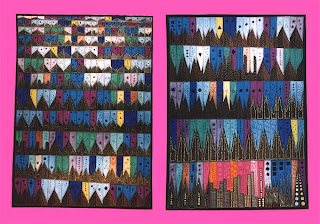
Bolero

Earthworm
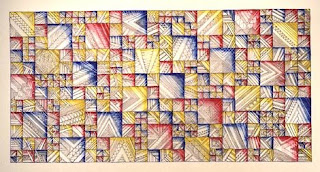
Migraine
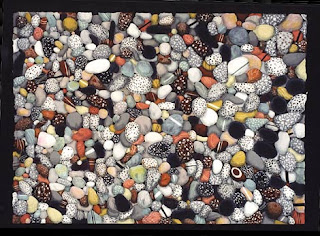
Pebbles
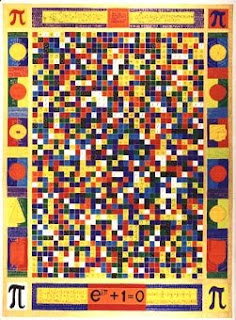
Pi
The article is sourced from The New York Times at
http://www.nytimes.com/2008/04/08/health/08brai.html?_r=1&oref=slogin
Of particular interest is the focus on structure and repetition. My Gran who is also suffering from dementia was often frustrated by patterns in materials that seemed wrong. Too many tiles of one colour or lines in the pavement not meeting objects placed on them symmetrically. I often find myself looking for similar patterns and wonder if there is a connection between this pattern structuring and the development of dementia.
The first of the images is a representation of 'Bolero,' a piece of music by Maurice Ravel, who was also suffering from frontemporal dementia.
"'Bolero' alternates between two main melodic themes, repeating the pair eight times over 340 bars with increasing volume and layers of instruments. At the same time, the score holds methodically to two simple, alternating staccato bass lines.
'‘Bolero’ is an exercise in compulsivity, structure and perseveration,' Dr. Miller said. It builds without a key change until the 326th bar. Then it accelerates into a collapsing finale."

Bolero

Earthworm

Migraine

Pebbles

Pi
Subscribe to:
Posts (Atom)